Application-focused colored surfacing systems engineered to improve skid resistance, traffic guidance and long-term durability across roads, bridges and public infrastructure.
Solution article
Bridge Cycle-Lane Corridor
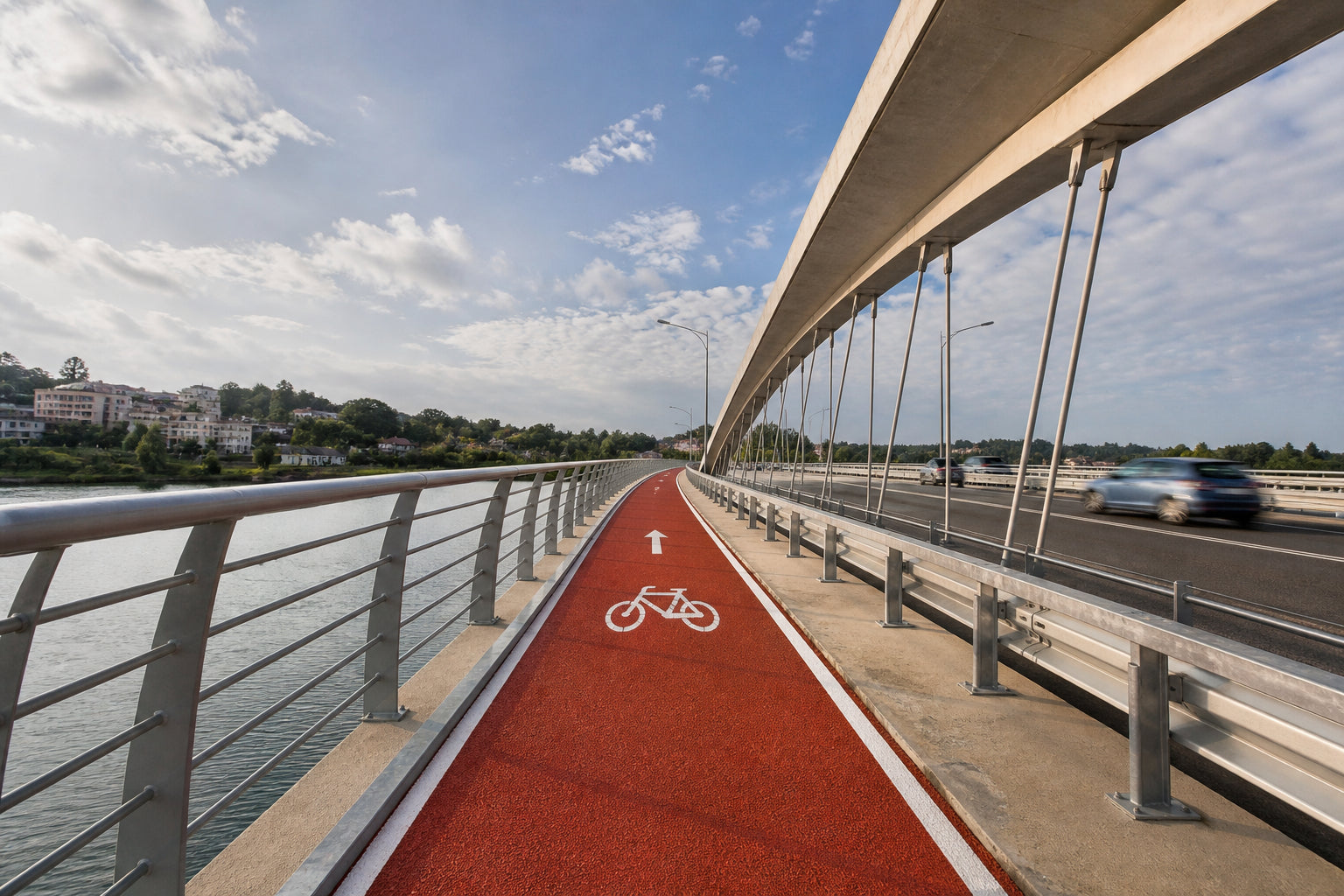
Colored high‑friction pavement enhances safety for bridge cycle‑lane corridors through clear visual lane division and dependable wet‑weather anti‑slip performance, protects bridge deck concrete, and enables efficient thin‑layer overlay construction with reduced maintenance costs.
admin
Bridge Cycle‑Lane Corridor
Bridge cycle‑lane corridors connect urban cycling networks across rivers and overpasses, yet they bring unique safety challenges. Exposed to open‑air wind, rain and temperature variation, bridge surfaces are often slippery when wet. Combined with fast‑moving motor vehicles, narrow deck space and frequent cross‑wind interference, bridge cycle‑lane corridors carry higher accident risks. Colored high‑friction pavement has become a reliable solution to improve safety and comfort for these vital cycling passages.
Distinct colored surfacing creates clear visual separation between bicycle corridors and motor‑vehicle lanes. It alerts drivers to watch for cyclists and helps riders stay within dedicated routes, reducing lane‑crossing conflicts on bridge decks. Even under strong cross‑wind conditions, the obvious color marking strengthens route perception for cyclists.
Superior anti‑slip performance is another key benefit. Mixed with hard‑wearing aggregates, the pavement retains high friction in rainy and damp weather. It effectively prevents skidding for two‑wheel traffic and lowers fall risks, which is critical for elevated bridge sections without shelter. Meanwhile, the surfacing works as a protective layer, sealing the bridge concrete substrate against rainwater and de‑icing salt penetration. It delays concrete spalling and steel‑bar corrosion, protecting the bridge structure itself.
Modern colored surfacing adopts thin‑layer overlay construction. It can be laid over existing bridge decks without large‑scale demolition. Fast‑curing properties shorten construction time and minimize lane closure influence on bridge traffic. With stable weather resistance and color retention, it cuts repeated maintenance work and lowers long‑term operating costs.
In summary, colored anti‑slip pavement improves safety for bridge cycle‑lane corridors via visual guidance and reliable wet‑weather friction, protects bridge concrete structures, and delivers cost‑effective renovation for urban cycling infrastructure.


 Highways
 Cycle Lanes
 Pedestrian Zones
 Bridges & Tunnels
 Parking
 School Zones
 Industrial
 Recreation