Application-focused colored surfacing systems engineered to improve skid resistance, traffic guidance and long-term durability across roads, bridges and public infrastructure.
Solution article
Improving Traction in Heavy Vehicle Turning Areas
High-friction surfacing improves traction and durability in heavy vehicle turning areas, providing a wear-resistant, skid-resistant solution for truck yards, logistics centers, ports, loading areas, and other high-stress industrial traffic zones.
admin
Improving Traction in Heavy Vehicle Turning Areas
Heavy vehicle turning areas are among the most demanding pavement zones in industrial facilities, logistics centers, ports, warehouses, and distribution yards. Trucks, trailers, container vehicles, forklifts, and other heavy equipment generate significant forces when turning, braking, and maneuvering at low speeds. These movements can accelerate surface wear and require reliable tire grip. High-friction surfacing for heavy vehicle turning areas provides a durable solution designed to improve traction, resist abrasion, and maintain surface performance under intensive industrial traffic.
Why Turning Areas Require Better Traction
Unlike vehicles traveling in a straight line, heavy vehicles create strong lateral forces when turning. Large trucks and trailers can place considerable stress on the pavement as tires rotate, drag, and change direction across a relatively small area.
The demands are even greater at tight corners, loading yards, terminal intersections, and maneuvering zones where vehicles repeatedly follow the same turning path.
Water, dust, oil, and other contaminants may further reduce pavement grip. A textured high-friction surface can provide better tire contact and help maintain traction during turning, braking, and acceleration.
High-Friction Surfacing for Heavy Traffic
High-friction surfacing typically combines a durable resin binder with selected wear-resistant aggregates to create a rough, skid-resistant surface.
For heavy vehicle applications, the surfacing system should be selected according to vehicle weight, traffic frequency, turning movements, substrate condition, and environmental exposure. A properly designed system can provide additional surface texture while protecting the underlying asphalt or concrete from everyday abrasion.
Areas experiencing repeated tire scrubbing and turning require particular attention because they may be exposed to greater mechanical stress than ordinary straight traffic lanes.
Colored Surfaces for Clearer Traffic Guidance
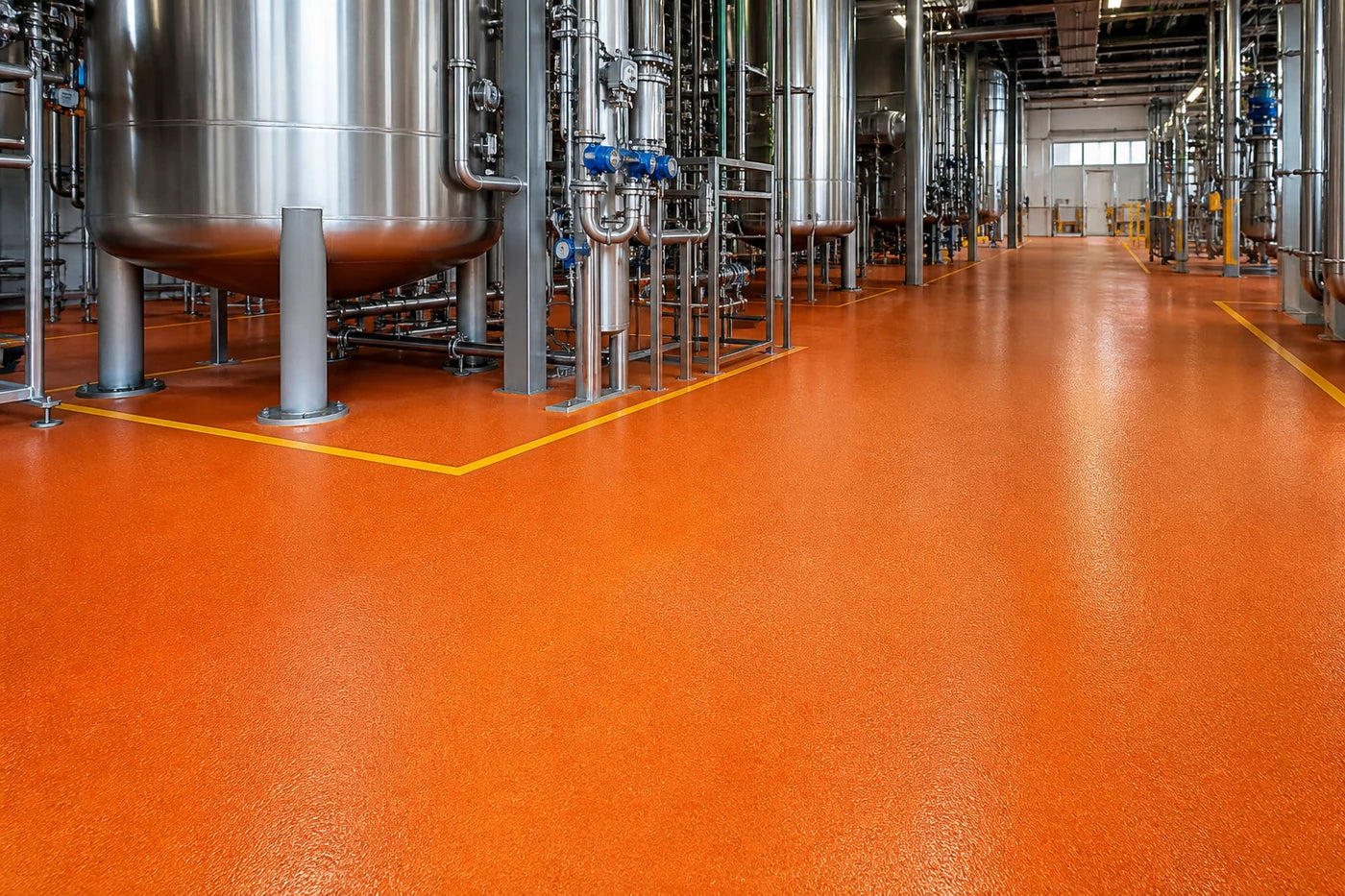
High-friction surfacing can also incorporate color to improve traffic organization in busy industrial environments. Contrasting surfaces can clearly identify truck turning zones, vehicle routes, loading areas, intersections, restricted areas, and pedestrian crossings.
Colored turning zones can help drivers recognize where vehicles are expected to change direction or maneuver. They can also be combined with arrows, lane boundaries, warning markings, and other traffic-control elements to create a clearer site layout.
This combination of high visibility and surface texture makes colored high-friction surfacing suitable for complex industrial traffic areas.
Where Can It Be Used?
Heavy-duty high-friction surfacing can be applied to truck turning areas, logistics yards, container terminals, warehouse access roads, loading docks, factory roads, distribution centers, industrial intersections, ramps, and heavy equipment maneuvering zones.
It is particularly useful at locations where vehicles repeatedly brake, turn sharply, reverse, or change direction.
Proper surface preparation is essential before installation. Existing pavement should be evaluated and cleaned to remove loose material, dust, oil, and other contaminants that could affect adhesion.
Built for Demanding Vehicle Movements
Improving traction in heavy vehicle turning areas requires a surface capable of handling both high traffic loads and repeated directional forces. High-friction surfacing combines enhanced tire grip, abrasion resistance, pavement protection, and optional color-coded traffic guidance.
With suitable materials, correct substrate preparation, and professional installation, a heavy-duty surfacing system can provide a durable solution for high-stress turning areas while helping create clearer and better-organized industrial vehicle routes.


 Highways
 Cycle Lanes
 Pedestrian Zones
 Bridges & Tunnels
 Parking
 School Zones
 Industrial
 Recreation