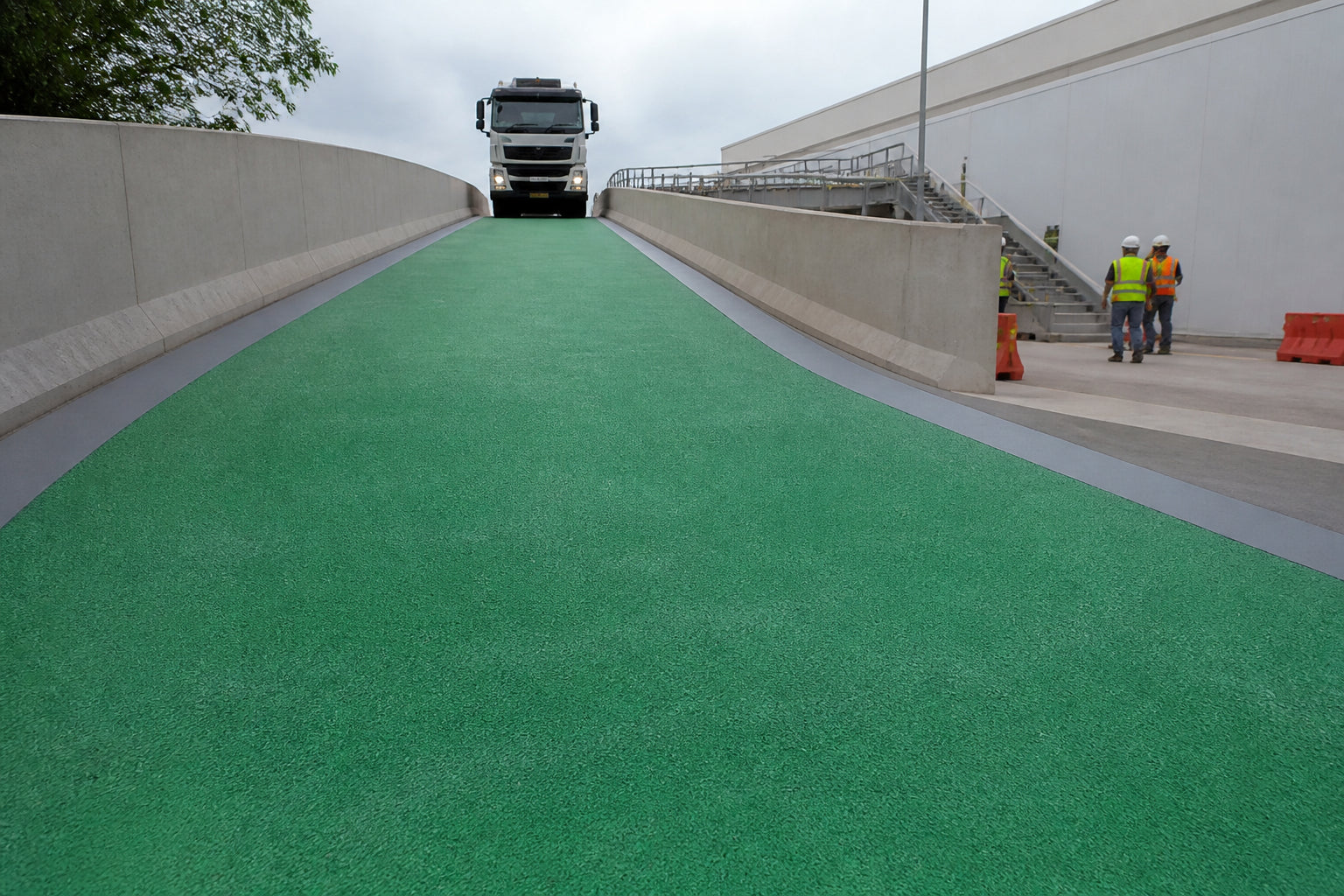
Application-focused colored surfacing systems engineered to improve skid resistance, traffic guidance and long-term durability across roads, bridges and public infrastructure.
Solution article
Colored Anti-Slip Surfacing for Industrial Ramps
Colored anti-slip surfacing for industrial ramps provides a durable, high-friction surface for factories, warehouses, loading areas, and logistics facilities, helping improve traction, traffic visibility, and surface protection in demanding industrial environments.
admin
Colored Anti-Slip Surfacing for Industrial Ramps
Industrial ramps are critical transition areas in factories, warehouses, logistics centers, loading bays, and other heavy-traffic facilities. These surfaces are frequently used by forklifts, trucks, material-handling vehicles, and workers, making reliable traction essential for safe and efficient operations. Colored anti-slip surfacing for industrial ramps provides a durable, high-friction solution designed to improve grip while clearly defining traffic routes and hazardous areas.
Industrial ramps can become slippery due to rain, moisture, oil, dust, or frequent vehicle movement. The problem can be particularly noticeable on steep gradients, loading ramps, and entrance or exit areas where vehicles regularly accelerate, brake, or change direction. Applying a high-friction anti-slip surface helps increase tire contact with the pavement and provides additional traction for both vehicles and pedestrians.
High-Friction Performance for Industrial Traffic
Colored anti-slip surfacing typically combines a durable resin binder with selected wear-resistant aggregates to create a textured, high-friction surface. The rough finish helps improve skid resistance, making it suitable for industrial ramps exposed to frequent forklift movements, delivery vehicles, and other operational traffic.
Compared with conventional smooth pavement surfaces, anti-slip treatments are particularly useful in locations where braking, turning, and gradient changes create greater demands on surface traction. The system can be applied to suitable concrete or asphalt substrates, depending on project requirements and surface preparation conditions.
Improved Visibility with Colored Surfacing
Color provides another important advantage in industrial environments. Different surface colors can be used to distinguish vehicle lanes, pedestrian routes, loading zones, ramp entrances, warning areas, and restricted sections.
For example, a contrasting colored anti-slip surface at the beginning of a ramp can provide a clear visual indication that drivers are approaching a gradient or traffic transition. Color coding can also support more organized traffic management within factories, warehouses, and logistics facilities.
Durable Protection for Demanding Environments
Industrial ramps are often exposed to repeated traffic, abrasion, weather conditions, and mechanical wear. A properly installed anti-slip surfacing system provides a tough protective layer over the underlying pavement while maintaining a textured surface for improved traction.
Good substrate preparation is essential for long-term performance. Before installation, the existing surface should be evaluated and cleaned to remove loose materials, contaminants, oil, and other substances that may affect adhesion. The appropriate resin, aggregate, thickness, and installation method should then be selected according to traffic conditions and project requirements.
Applications of Industrial Ramp Anti-Slip Surfacing
Colored anti-slip surfacing can be used for factory entrance ramps, warehouse loading ramps, logistics center access roads, parking ramps, forklift routes, truck loading areas, and other sloped industrial traffic surfaces.
By combining high-friction performance, visual traffic guidance, surface protection, and colored identification, colored anti-slip surfacing provides a practical solution for industrial ramps where both durability and traffic safety are important. It can also help create clearer, more organized traffic areas while improving the overall appearance of industrial facilities.


 Highways
 Cycle Lanes
 Pedestrian Zones
 Bridges & Tunnels
 Parking
 School Zones
 Industrial
 Recreation