Application-focused colored surfacing systems engineered to improve skid resistance, traffic guidance and long-term durability across roads, bridges and public infrastructure.
Solution article
Keeping Logistics Yard Traffic Moving with Durable High-Friction Surfacing
Durable high-friction surfacing helps keep logistics yard traffic moving by improving vehicle traction, resisting heavy traffic wear, and creating clearly defined routes for trucks, forklifts, and other material-handling equipment.
admin
Keeping Logistics Yard Traffic Moving with Durable High-Friction Surfacing
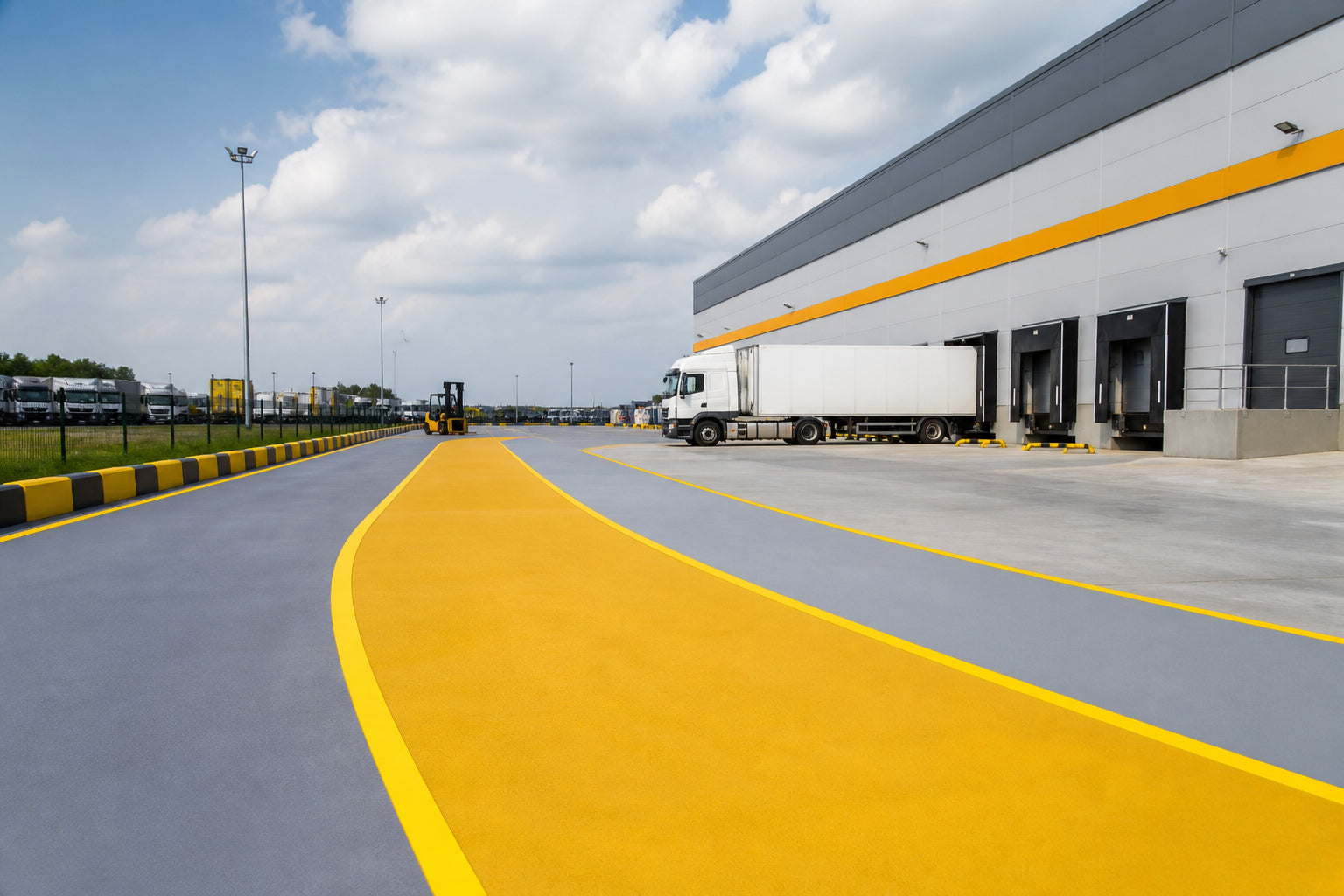
Logistics yards are high-traffic environments where trucks, trailers, forklifts, terminal tractors, and other commercial vehicles move continuously between warehouses, loading docks, storage areas, and distribution points. Frequent braking, turning, reversing, and heavy vehicle loads can place considerable stress on pavement surfaces. Durable high-friction surfacing for logistics yards provides a practical solution for improving traction, resisting surface wear, and creating clearly defined vehicle routes in demanding logistics environments.
Reliable Traction for Busy Logistics Yards
Vehicle movements within a logistics yard are different from normal road traffic. Trucks often operate at lower speeds while making frequent turns, stops, and reversing movements. These repeated actions can create concentrated stress on specific pavement areas.
Rain, dust, oil, dirt, and other contaminants may also reduce tire grip, particularly around loading docks, intersections, and turning areas.
High-friction surfacing creates a textured finish that provides additional contact between vehicle tires and the pavement. A suitable system can combine a durable resin binder with wear-resistant aggregates to produce a tough, skid-resistant surface for frequently used traffic routes.
Built to Handle Heavy Vehicle Traffic
Logistics yards need surfaces capable of supporting loaded trucks, trailers, forklifts, and material-handling equipment throughout daily operations. Repeated wheel movements, heavy axle loads, braking, and tire scrubbing can contribute to gradual pavement deterioration.
A properly designed high-friction surfacing system adds a durable wearing layer over suitable asphalt or concrete substrates. Material selection should take into account traffic volume, vehicle type, turning frequency, substrate condition, and environmental exposure.
High-stress areas such as intersections, loading approaches, ramps, and truck turning zones may particularly benefit from additional abrasion resistance and surface texture.
Color-Coded Routes for Better Traffic Organization
High-friction surfacing can also incorporate color to make logistics traffic routes easier to identify. Colored pavement provides clear visual separation between different functional areas and can support a more organized yard layout.
Different colors can be used to identify truck lanes, forklift routes, loading zones, pedestrian crossings, parking areas, restricted sections, and hazard zones.
Colored surfaces can also be combined with directional arrows, stop markings, lane boundaries, and other traffic symbols. This helps drivers quickly understand traffic patterns when entering or moving through a busy logistics facility.
Suitable for Critical Logistics Areas
Durable high-friction surfacing can be used across distribution centers, warehouse yards, freight terminals, truck loading areas, logistics parks, container yards, delivery routes, loading dock approaches, and vehicle maneuvering areas.
It is particularly suitable for locations exposed to frequent acceleration, braking, turning, or heavy vehicle movements.
Proper substrate preparation is essential before application. Existing pavement should be evaluated and cleaned to remove loose materials, dust, oil, grease, and other contaminants that could affect adhesion and long-term performance.
Supporting Efficient Logistics Operations
A well-designed logistics yard depends on clear traffic routes and durable pavement. High-friction surfacing combines enhanced tire grip, wear resistance, pavement protection, and color-coded traffic guidance in one practical surface treatment.
With suitable materials and professional installation, durable high-friction surfacing can help logistics yards maintain clearly defined traffic routes while providing the robust surface performance required for continuous truck and material-handling operations.


 Highways
 Cycle Lanes
 Pedestrian Zones
 Bridges & Tunnels
 Parking
 School Zones
 Industrial
 Recreation