Application-focused colored surfacing systems engineered to improve skid resistance, traffic guidance and long-term durability across roads, bridges and public infrastructure.
Solution article
Art Underfoot: Creative Colored Surfacing for Urban Spaces
Creative colored surfacing transforms urban pavement into public art, combining decorative patterns, vibrant colors, anti-slip performance, and visual wayfinding for plazas, cultural districts, parks, and pedestrian spaces.
admin
Art Underfoot: Creative Colored Surfacing for Urban Spaces
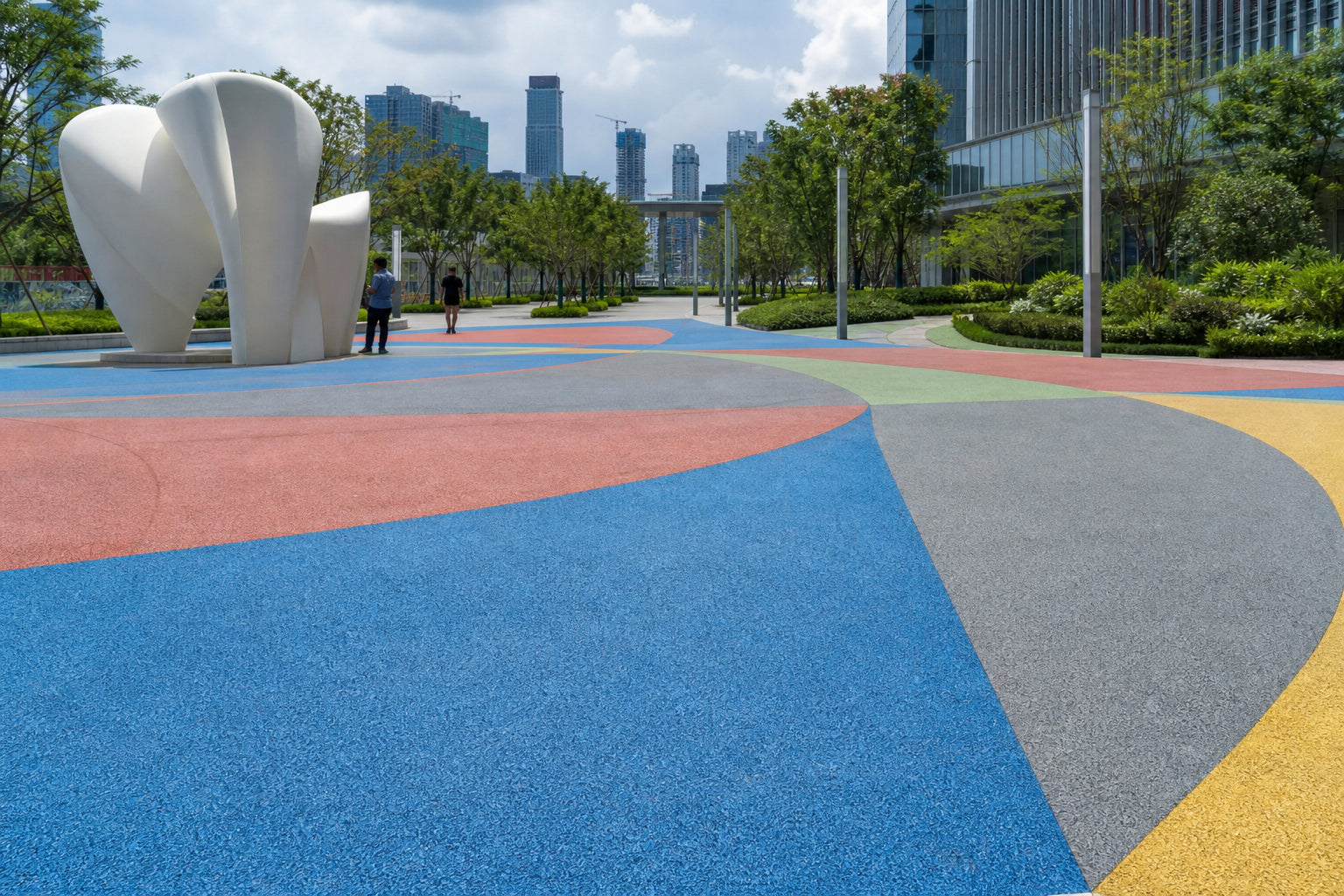
Public art is no longer limited to sculptures, murals, and installations. In modern urban design, the ground itself can become part of the creative experience. Creative colored surfacing for urban spaces combines decorative pavement, anti-slip performance, and artistic design to transform ordinary walkways and plazas into distinctive public environments.
Turning Pavement into Public Art
Traditional pavement is often treated as a purely functional surface. Colored surfacing changes this approach by allowing designers to incorporate artistic patterns, geometric forms, flowing lines, and contrasting colors directly into the ground.
A plaza might feature large abstract shapes inspired by local culture, while a pedestrian street can use colorful patterns to connect public artworks and important destinations. Parks and cultural districts can also incorporate pavement designs that complement sculptures, landscape features, or surrounding architecture.
In this way, the surface becomes an active part of the overall public art concept.
More Creative Freedom with Color
Colored pavement provides designers with a wide range of visual possibilities. Red, blue, green, yellow, beige, and natural earth tones can be used individually or combined to create distinctive designs.
Different colors can define art zones, pedestrian routes, gathering spaces, event areas, viewing points, and interactive public spaces.
Curved color bands can create movement across a plaza, while geometric patterns can complement contemporary architecture. Custom designs can also help give a neighborhood, cultural venue, or commercial district its own recognizable identity.
Combining Art with Anti-Slip Performance
Creative pavement still needs to perform as a practical walking surface. Public spaces are exposed to rain, moisture, dust, and continuous pedestrian traffic.
Colored surfacing can incorporate selected anti-slip aggregates to create a textured, high-friction finish. This allows artistic pavement designs to provide decorative value while maintaining the surface characteristics required for busy outdoor environments.
The appropriate texture and materials can be selected according to pedestrian traffic, climate, substrate conditions, and project requirements.
Connecting Art, People, and Place
One of the strengths of artistic colored pavement is its ability to connect different elements of a public space. A colored surface can extend visually from a sculpture, guide visitors toward an exhibition area, or create a distinctive gathering space around an artwork.
Colored pavement can also support wayfinding by connecting public art installations, cultural venues, commercial streets, parks, plazas, and pedestrian destinations.
Rather than treating pavement and public art as separate features, designers can integrate them into one coordinated landscape.
Creating Memorable Urban Spaces
Creative colored surfacing is suitable for public plazas, art districts, museums, cultural centers, pedestrian streets, parks, commercial areas, waterfronts, and community spaces.
By combining artistic expression, decorative color, anti-slip texture, wayfinding, and durable surface performance, colored surfacing can transform ordinary pavement into an engaging part of the urban landscape.
When art moves from the wall to the ground, pavement becomes more than a surface—it becomes part of how people experience and remember a place.


 Highways
 Cycle Lanes
 Pedestrian Zones
 Bridges & Tunnels
 Parking
 School Zones
 Industrial
 Recreation