Application-focused colored surfacing systems engineered to improve skid resistance, traffic guidance and long-term durability across roads, bridges and public infrastructure.
Solution article
Why Do Loading and Service Bays Need Anti-Slip Surfacing?
Anti-slip surfacing provides improved traction, wear resistance, and clear traffic-zone identification for loading and service bays exposed to delivery vehicles, forklifts, pedestrians, and frequent maneuvering.
admin
Why Do Loading and Service Bays Need Anti-Slip Surfacing?
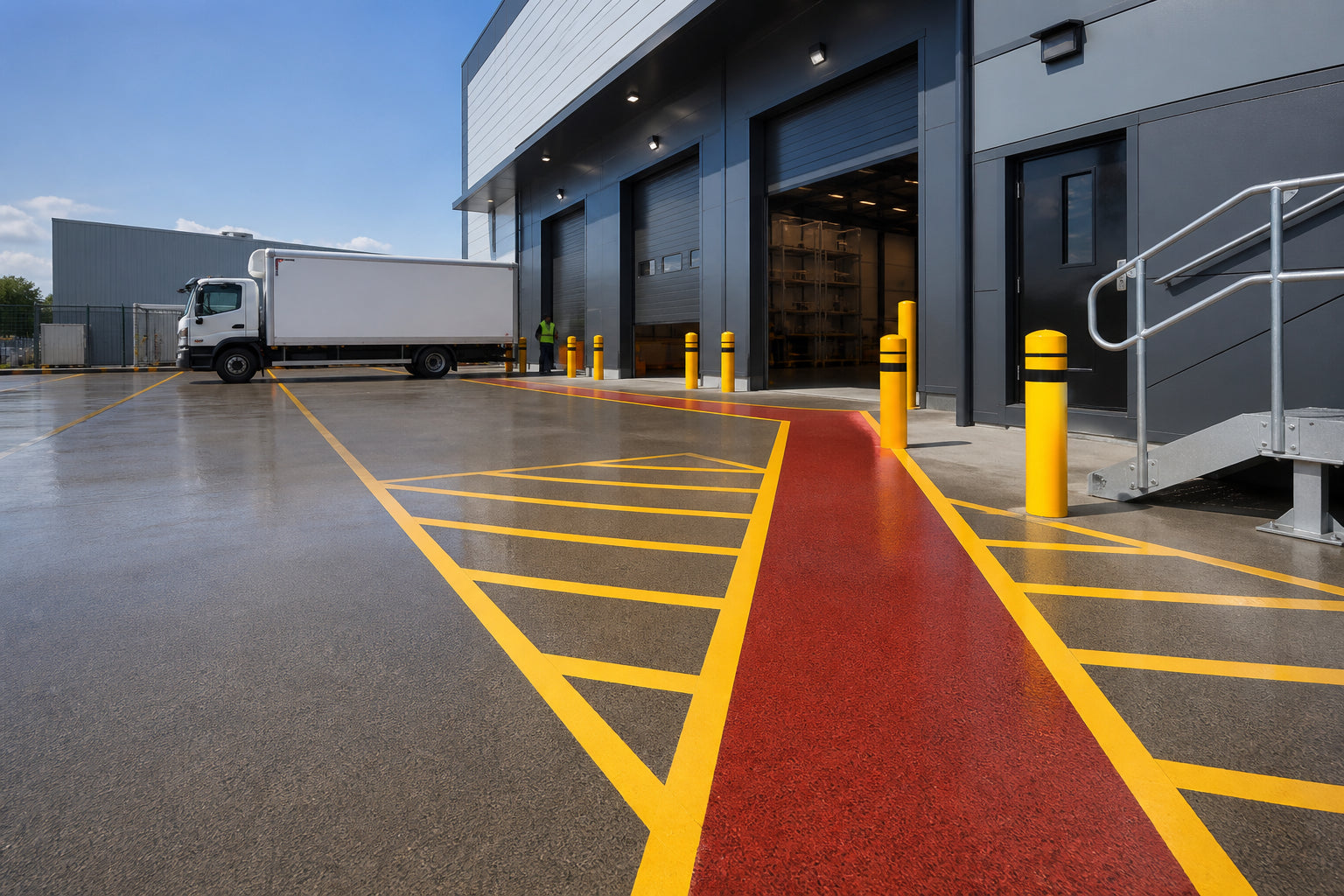
Loading and service bays are essential operational areas in shopping centres, commercial buildings, warehouses, hotels, parking facilities, and logistics centres. Delivery trucks, service vehicles, forklifts, trolleys, and workers may all use these spaces throughout the day. Frequent braking, reversing, turning, and loading activities create demanding surface conditions. Anti-slip surfacing for loading and service bays provides improved traction, durable surface protection, and clearer traffic-zone identification for busy service environments.
Why Is Traction Important in Loading Bays?
Loading bays often experience more complex vehicle movements than standard parking areas. Delivery vehicles may need to reverse into narrow spaces, make tight turns, stop on ramps, or repeatedly accelerate and brake.
Water, dust, oil, dirt, and other contaminants can also affect surface grip. In outdoor or partially covered loading areas, rainwater and moisture may create additional challenges.
Anti-slip surfacing uses selected aggregates to create a textured, high-friction finish. This additional texture can improve tire contact with the surface while also providing better grip for pedestrians working around vehicles and loading equipment.
Can Anti-Slip Surfacing Handle Heavy Traffic?
Loading and service areas need surfaces capable of handling frequent commercial vehicle movements. Delivery trucks, vans, forklifts, pallet trucks, and maintenance vehicles can create repeated mechanical wear.
A properly designed anti-slip surfacing system provides a durable wearing layer over suitable concrete or asphalt substrates. Wear-resistant aggregates can help maintain surface texture, while a suitable binder provides adhesion and protection for the underlying pavement.
Material selection should consider vehicle types, traffic frequency, loading conditions, turning movements, substrate condition, and environmental exposure.
How Does Colored Surfacing Improve Organization?
Anti-slip surfacing can also incorporate color to make different operational areas easier to identify.
Colored surfaces can distinguish loading bays, delivery routes, pedestrian walkways, vehicle lanes, restricted areas, hazard zones, and service entrances. Contrasting colors can highlight areas where vehicles frequently reverse or where pedestrians cross active traffic routes.
Directional arrows, bay numbers, warning markings, and boundary lines can also be integrated with the colored pavement to create a clearer traffic layout.
Where Can It Be Used?
Anti-slip surfacing is suitable for shopping centre loading docks, commercial service bays, warehouse delivery areas, hotel service entrances, supermarket loading zones, logistics facilities, underground service areas, and parking structures.
It can be particularly useful on ramps, turning areas, dock approaches, and other locations exposed to frequent braking or maneuvering.
A Practical Surface for Busy Service Areas
Loading and service bays require a balance of traction, durability, and clear traffic organization. Anti-slip surfacing combines high-friction texture, wear resistance, surface protection, and optional color-coded guidance in one practical system.
With appropriate substrate preparation and material selection, anti-slip surfacing can provide a durable solution for busy loading environments while helping clearly separate vehicles, pedestrians, and operational zones.


 Highways
 Cycle Lanes
 Pedestrian Zones
 Bridges & Tunnels
 Parking
 School Zones
 Industrial
 Recreation