Application-focused colored surfacing systems engineered to improve skid resistance, traffic guidance and long-term durability across roads, bridges and public infrastructure.
Solution article
How Can Colored Surfacing Improve Fire Lane Visibility?
Colored surfacing improves fire lane visibility by creating clearly defined emergency access routes with strong visual contrast, anti-slip texture, and durable pavement performance for busy parking and commercial areas.
admin
How Can Colored Surfacing Improve Fire Lane Visibility?
Fire lanes provide essential access for fire engines, rescue vehicles, and other emergency services around commercial buildings, parking facilities, residential developments, warehouses, and public spaces. These routes need to remain clearly identifiable so drivers and pedestrians can distinguish them from ordinary parking and traffic areas. Colored surfacing for fire lanes provides a highly visible pavement treatment that can combine clear route identification with anti-slip texture and durable surface performance.
Making Fire Lanes Easier to Recognize
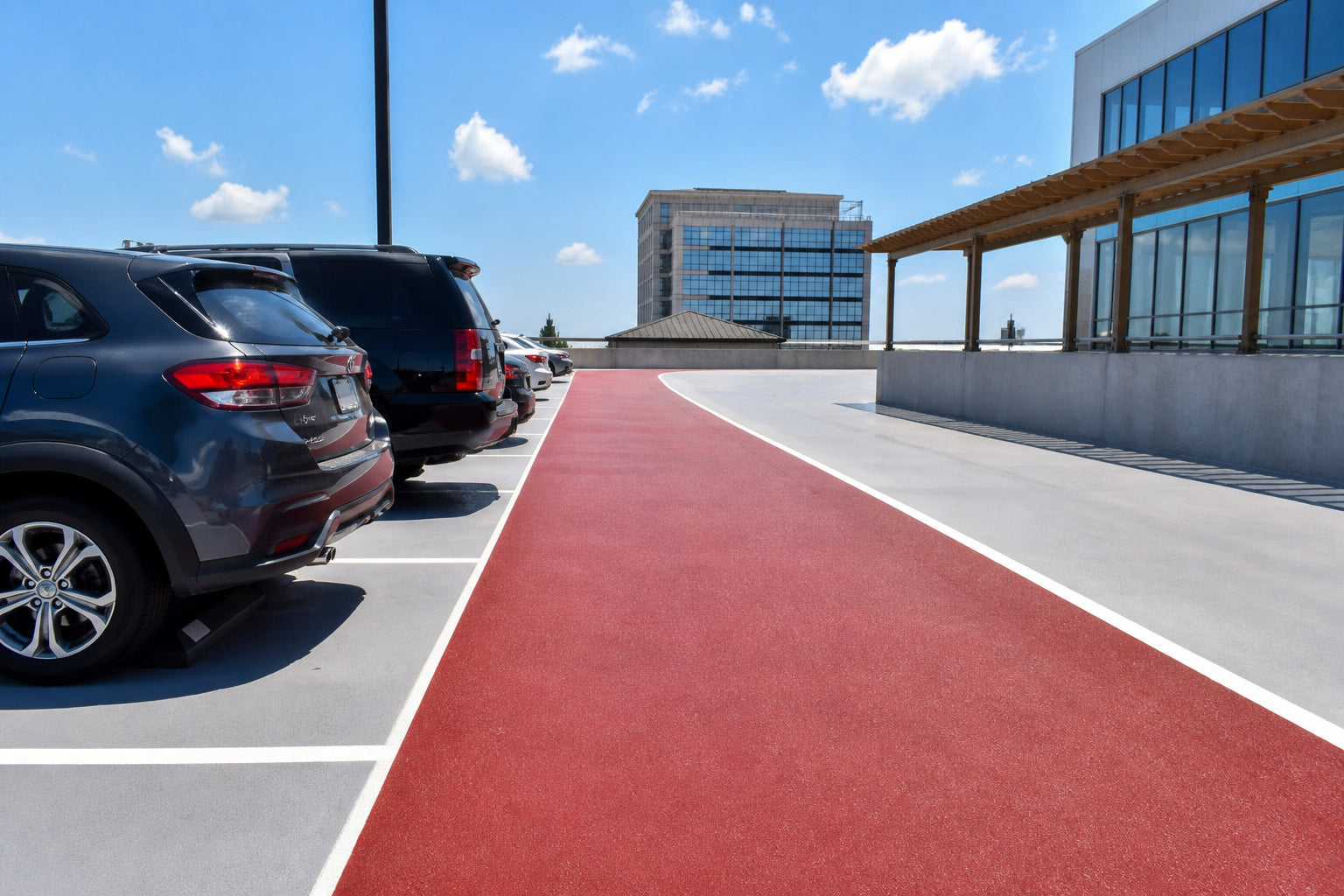
In busy parking facilities, conventional line markings may sometimes be less visually prominent than a fully colored surface. Colored pavement can create stronger contrast between a designated fire lane and surrounding vehicle or parking areas.
Depending on local requirements, an appropriate color can be used across the entire lane or in selected sections. The surface can also be combined with FIRE LANE markings, boundary lines, emergency access symbols, directional arrows, and no-parking markings.
This creates a continuous visual route that can be recognized from a greater distance.
How Does Color Support Emergency Access?
Fire lanes often run alongside buildings, through parking facilities, or around loading and service areas. In these environments, vehicles may accidentally stop or park in locations intended for emergency access.
A clearly differentiated pavement surface helps emphasize the purpose of the route. Colored surfacing can highlight fire engine access lanes, emergency entrances, turning areas, building approaches, and designated stopping zones.
Consistent color treatment throughout a site can also help connect separate sections of an emergency access route.
Adding Anti-Slip Performance
Visibility is only one consideration. Emergency vehicles may need to accelerate, brake, or turn quickly, while outdoor fire lanes can be exposed to rain, dust, oil, and other contaminants.
Colored surfacing can incorporate selected aggregates to produce a textured, high-friction finish. This provides additional tire contact with the pavement while maintaining the visual contrast required for route identification.
High-friction treatment can be particularly useful on ramps, curves, intersections, and emergency vehicle turning areas.
Durable for Outdoor Traffic Areas
Fire lanes may also experience normal service, maintenance, or authorized vehicle traffic. Surfacing materials therefore need to withstand repeated vehicle movement and environmental exposure.
A properly designed colored surfacing system can be installed over suitable asphalt or concrete substrates. Material selection should consider traffic volume, weather conditions, UV exposure, drainage, substrate condition, and required surface texture.
Colors and markings should always follow applicable local fire codes, accessibility requirements, and traffic regulations.
Creating Clearly Defined Fire Access Routes
Colored surfacing can be used around shopping centres, parking facilities, hospitals, warehouses, residential communities, office buildings, industrial facilities, and public venues.
By combining high visibility, anti-slip texture, durable surface protection, and clear route identification, colored surfacing can make fire lanes easier to distinguish from surrounding traffic areas. When designed according to local regulations, it provides a practical way to support clear and recognizable emergency access throughout a property.


 Highways
 Cycle Lanes
 Pedestrian Zones
 Bridges & Tunnels
 Parking
 School Zones
 Industrial
 Recreation