Application-focused colored surfacing systems engineered to improve skid resistance, traffic guidance and long-term durability across roads, bridges and public infrastructure.
Solution article
Tight Turns, Better Grip: Surfacing for Multi-Storey Car Parks
High-friction surfacing provides improved tire grip, wear resistance, and colored visual guidance for tight turns, curved ramps, and high-traffic turning zones in multi-storey car parks.
admin
Tight Turns, Better Grip: Surfacing for Multi-Storey Car Parks
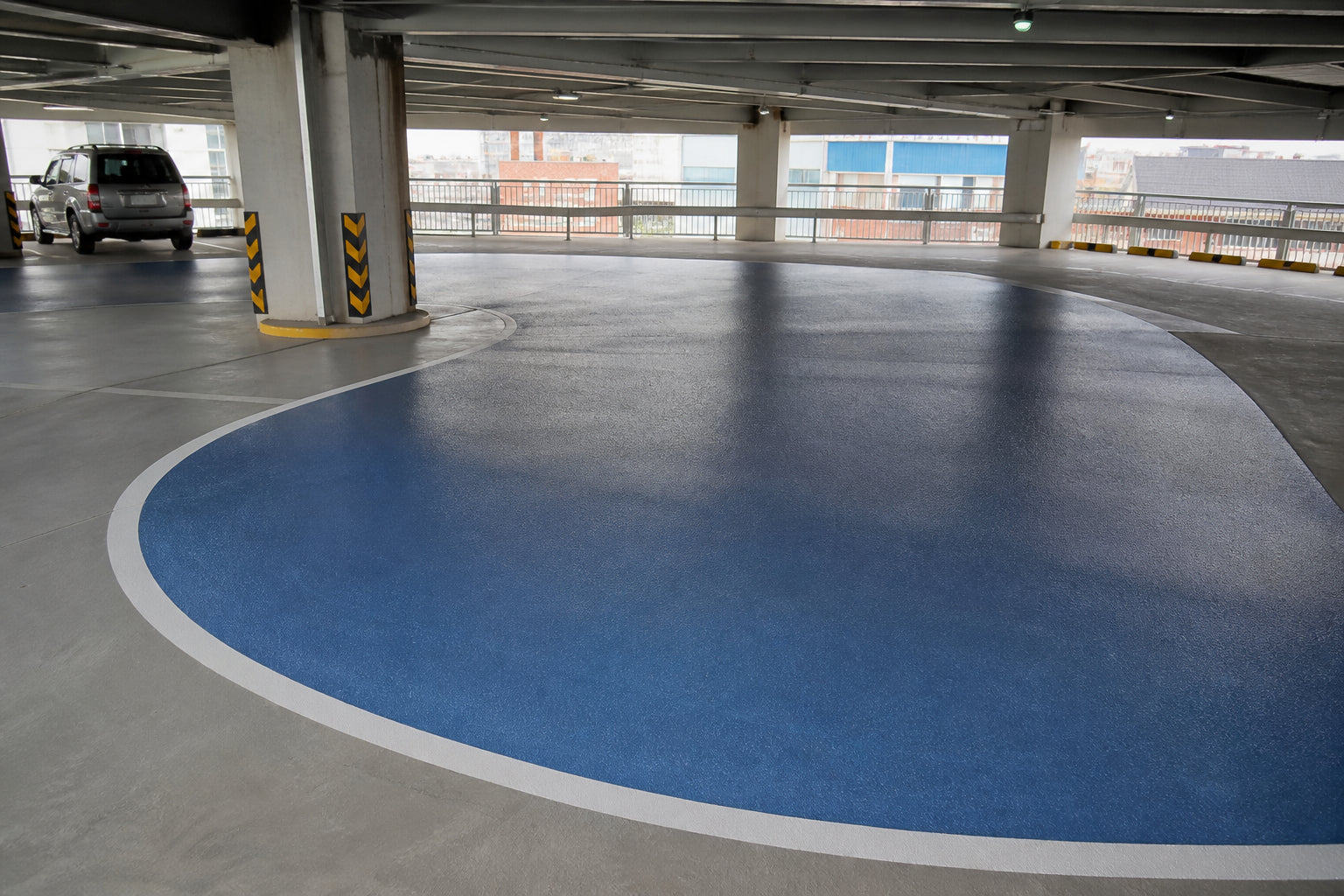
Multi-storey car parks often include narrow lanes, steep ramps, tight corners, and limited turning space. Vehicles must frequently slow down, brake, steer sharply, and accelerate again while moving between parking levels. These repeated movements place significant demands on the pavement, particularly in curved sections. High-friction surfacing for multi-storey car parks provides improved tire grip, durable surface protection, and clear visual guidance for challenging turning zones.
Why Do Tight Turns Need Better Grip?
Turning areas experience different stresses from straight traffic lanes. When vehicles make tight turns at low speeds, tires can generate lateral forces and repeated surface friction. Over time, these movements may contribute to wear on conventional concrete or asphalt surfaces.
Water carried into the garage by vehicles, dust, oil, and tire deposits can also affect surface traction.
A textured high-friction surface provides additional tire contact, making it particularly suitable for tight corners, curved ramps, spiral ramps, level transitions, and other high-stress turning areas.
High-Friction Surfacing for Parking Curves
Anti-slip surfacing typically uses selected aggregates combined with a durable binder to create a textured, skid-resistant finish.
The appropriate surface system should be selected according to traffic frequency, turning radius, ramp gradient, substrate condition, and expected vehicle movements. Areas where vehicles repeatedly brake and steer may require additional attention to abrasion resistance and long-term adhesion.
Proper preparation of the existing substrate is also important for achieving reliable performance.
Using Color to Guide Drivers
Multi-storey parking facilities can be difficult to navigate, particularly when multiple levels and ramps have similar appearances. Colored surfacing can provide an additional layer of visual guidance.
Contrasting colors can highlight turning zones, ramp edges, directional routes, pedestrian crossings, level transitions, entrances, and exits.
A colored section before a tight curve can visually indicate a change in direction, while continuous colored lanes can guide drivers between different parking levels. Directional arrows and warning markings can be incorporated into the surface design for additional clarity.
Built for Repeated Vehicle Movement
Turning zones are exposed to concentrated tire movement throughout the day. A durable surfacing system can help protect the underlying pavement while maintaining a textured finish under regular vehicle traffic.
High-friction surfacing can be applied to suitable concrete or asphalt substrates depending on the selected system. Aggregate type, binder performance, surface thickness, and installation conditions should be matched to the requirements of the parking facility.
Better Surfaces for Challenging Parking Areas
High-friction surfacing is suitable for multi-storey car parks, underground garages, spiral ramps, curved parking lanes, entrance and exit ramps, turning zones, and level transition areas.
By combining improved tire grip, abrasion resistance, colored traffic guidance, and durable surface protection, high-friction surfacing provides a practical solution for tight turning areas.
For multi-storey car parks where drivers regularly navigate narrow curves and ramps, the right surface can provide both the traction and visual guidance needed for clearer, more efficient vehicle circulation.


 Highways
 Cycle Lanes
 Pedestrian Zones
 Bridges & Tunnels
 Parking
 School Zones
 Industrial
 Recreation