Application-focused colored surfacing systems engineered to improve skid resistance, traffic guidance and long-term durability across roads, bridges and public infrastructure.
Solution article
Guiding Pedestrians with Colored Transit Walkways
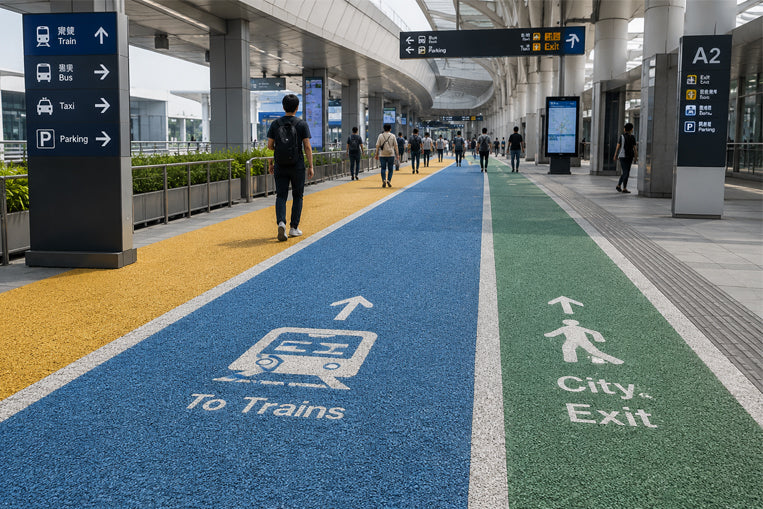
Colored transit walkways combine visual wayfinding, anti-slip performance, and durable surfacing to create clearly defined pedestrian routes between stations, platforms, parking areas, and other transport connections.
admin
Guiding Pedestrians with Colored Transit Walkways
Transit interchanges are busy environments where large numbers of passengers move between buses, trains, metro stations, taxi areas, parking facilities, and surrounding streets. Clear pedestrian routes are essential for helping people move efficiently between different transport services. Colored transit walkways provide a practical way to improve visual guidance while combining anti-slip performance, durable surfacing, and clear pedestrian-zone identification.
Making Pedestrian Routes Easasier to Follow
Large transport hubs can contain multiple entrances, platforms, exits, crossings, and transfer points. For passengers who are unfamiliar with the facility, finding the correct route can sometimes be challenging.
Colored walkways can create continuous visual paths between important destinations. Different colors may be used to identify routes leading to bus platforms, railway stations, metro entrances, taxi zones, parking areas, and pedestrian exits.
When combined with directional arrows, symbols, and signs, colored pavement can become an intuitive part of the overall wayfinding system.
Using Color to Organize Passenger Flow
Color can also help organize pedestrian movement in areas where several routes intersect. A continuous colored path can guide passengers through the main circulation corridor, while contrasting surfaces can highlight crossings, waiting zones, or important decision points.
Different pavement colors can separate walking routes from bicycle lanes, vehicle areas, service zones, and other transport functions.
This visual separation is especially useful in busy interchange areas where pedestrians and vehicles operate close to each other.
Anti-Slip Performance for High-Traffic Walkways
Transit walkways experience intensive pedestrian traffic throughout the day and may be exposed to rain, moisture, dust, and other contaminants.
Colored anti-slip surfacing can incorporate selected aggregates to create a textured, high-friction finish. The additional surface texture provides improved grip underfoot while maintaining the strong visual contrast needed for pedestrian guidance.
Surface texture should also be selected with accessibility and comfortable movement in mind, particularly for passengers using wheelchairs, mobility devices, luggage, or strollers.
Durable Surfacing for Transit Environments
Pedestrian routes at transit interchanges may experience thousands of daily movements as well as luggage trolleys, maintenance carts, bicycles, and cleaning equipment.
A properly designed colored surfacing system can provide a durable wearing layer over suitable asphalt or concrete substrates. Material selection should consider pedestrian volume, weather exposure, drainage, substrate condition, abrasion resistance, and maintenance requirements.
Creating Clearer Transit Connections
Colored transit walkways can be used in railway stations, metro interchanges, bus terminals, airports, park-and-ride facilities, transport hubs, and multimodal transit centers.
By combining visual wayfinding, color-coded routes, anti-slip texture, and durable surface performance, colored walkways can make complex transit environments easier to navigate. From arrival to transfer and final exit, clearly defined pedestrian routes can help create a more intuitive connection between different modes of transport.


 Highways
 Cycle Lanes
 Pedestrian Zones
 Bridges & Tunnels
 Parking
 School Zones
 Industrial
 Recreation